First off, I gotta start off with the typical Disclaimer.
*ahem*
This is a tutorial based off of MY knowledge and MY experience. My advice is just that, advice, and is not is anyway, shape or form, absolute. I am still learning and do not consider myself a professional or expert. Look at other sources, look at other materials, expand your inspiration, don’t just look at this tutorial and call it good. And most importantly have fun~
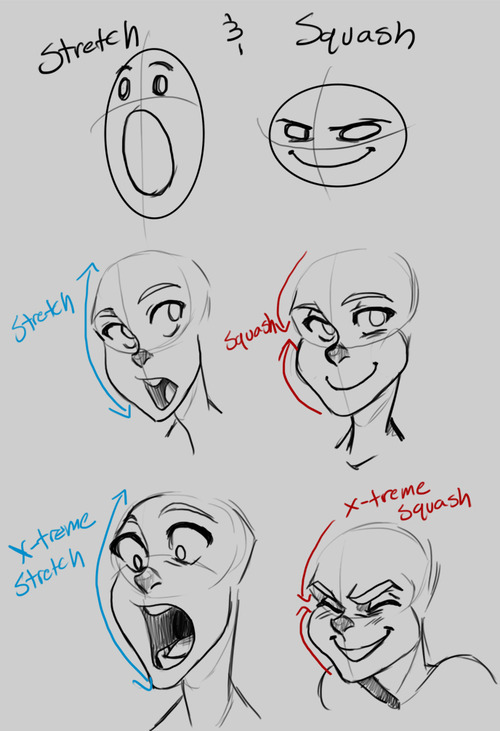
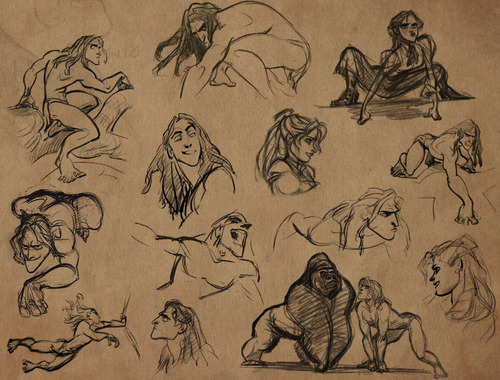
Alright, with that out of the way, before I can get to the actual expressions, we need to discuss an important concept known as “Squash and Stretch.” You’ve probably heard of it before. Squash and Stretch was a method that was invented (I use this term a bit loosely) by Freddie Moore, a Disney animator from the 1930s to 1940s. He was the animator for the Dwarves in Snow White and he gave these characters a spongy flexibility that made them feel more real and gave pliability to the face that made them come more alive.
Even outside the world of animation, Squash and Stretch is essential and you’re going to squeeze much more life out of your characters if you understand and are willing to push the weight and flexibility of their faces. This also doesn’t only apply to cartoons, look in the mirror and make funny faces and strange expressions and you’ll notice how squishy your face is.
The next concept to be aware of is the Acting Elements of the Face. This is a concept I never really thought about until I read Tom Bancroft’s Character Mentor, a book I have recommended many times. The Acting Elements are the basics of character expression and focuses on breaking down the elements of the face in order of importance to properly communicate an expression to the audience. These are not set in stone and a lot of times their order can be switched around depending on the expression. This is the default order Bancroft uses in his book:
1) The eyes
2) The eyebrows
3) The mouth
4) The neck
5) The nose
I’m not going to go into much detail about this; otherwise this tutorial will run on forever, so DEFINITELY give Character Mentor a look for a better understanding.
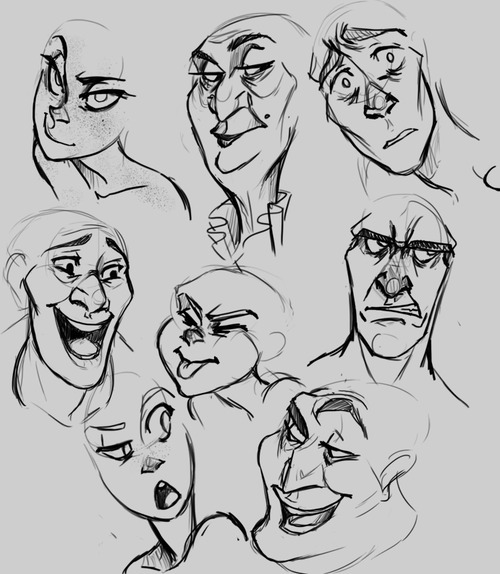
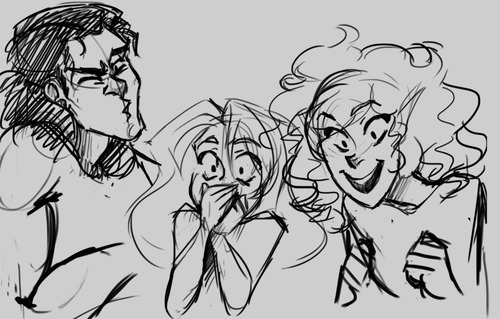
Here are some expressions I whipped up, notice the different ways each of the above elements contributes to the overall expression. Try to identify which element is strongest in each one. Also notice how some elements repeat (such as the use of the eyebrows in the bottom two) but they’re still different expressions.
I personally find that I always build from the eyes out when building an expression. Ever heard the phrase “The eyes are the windows to the soul?” well guess what? THE EYES ARE THE WINDOWS TO THE SOUL! This is why people look away when their embarrassed, why their gaze shifts when they’re lying, why their eyes grow wide in awe. It’s what makes a hero seem cold when they hold their gaze at the display of heartless behavior or gives a villain a moment of redemption when they turn away from a cruelty.
Part of the reason why Glen Keane’s characters are so incredible is the way he expresses a character through their eyes. He says “If you’re going to make a mistake, don’t make it in the eyes. Because everybody’s looking at the eyes.” He creates these characters that are filled with passion and before that passion translates into body language or into an expression, if bursts out through the eyes.
Remember when I brought up that the order of the Acting Elements is flexible? As I said, I tend to start with the eyes when expressing and character but sometimes that just doesn’t “work” with the character. Take a look a Max, from Cats Don’t Dance (if you haven’t seen the film, I highly recommend it, even if just for the animation). His face is almost ALWAYS in the same position, with the same expression, completely stiff. The only thing that moves is his mouth and it’s animated in a way that is both comical and intimidating! This is a common theme with his character, fluid motion against unmoving bulk. It contrasts and guess what? Contrast creates interest! <——Remember this phrase, because it applies to everything!
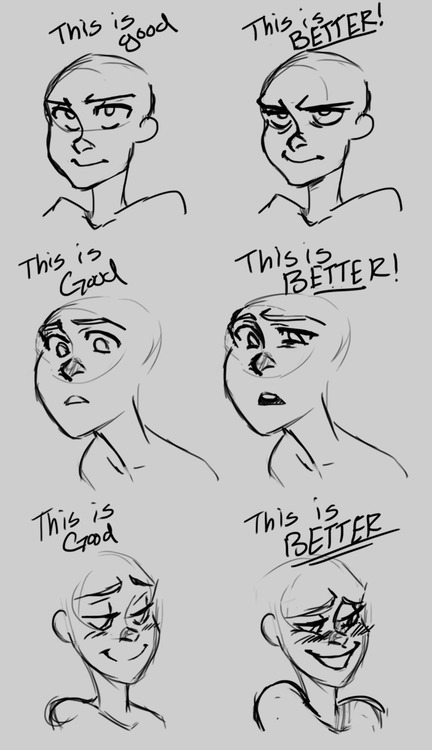
Next, pushing your expressions. Don’t be afraid to add that extra “umph” to a characters expression. Unless you’re animating, you don’t have the luxury of constant motion and steady frames, so make the most of a scene, make it clear to your audience what your character is feeling. Check out some of these simple examples below.
Now some of you probably thought the first expression was better than the second. And you know, you may be right! Sometimes a subtler expression speaks volumes more than a more obvious one. It’s important, however, to understand to how to make the most use of your character’s face. But in the end it all boils down to the character. Which leads me to my final segment of this tutorial…
A character should express themselves through their emotions. Just like costumes, colors, body language, etc. expressions are ultimately a tool used describe a character, to visually tell a story about them. When dealing with different characters, try to avoid “recycling” expressions, ESPECIALLY in the same scene/picture/moment. A good exercise is to draw two or three different characters with the same emotion but give them different expressions.
Or better yet, draw them reacting to the same situation.
Your goal should be to make each expression true to the character. Their expressions should tell the audience something about them. The same way you might bold a word or phrase to emphasize its meaning, a character should express themselves in ways that emphasize who they are.
Tag: for later
LET'S MAKE SOME MOTHERFUCKING MAPS
chrc:
YOU NEED
A BIG SHEET OF PAPER & A PENCIL
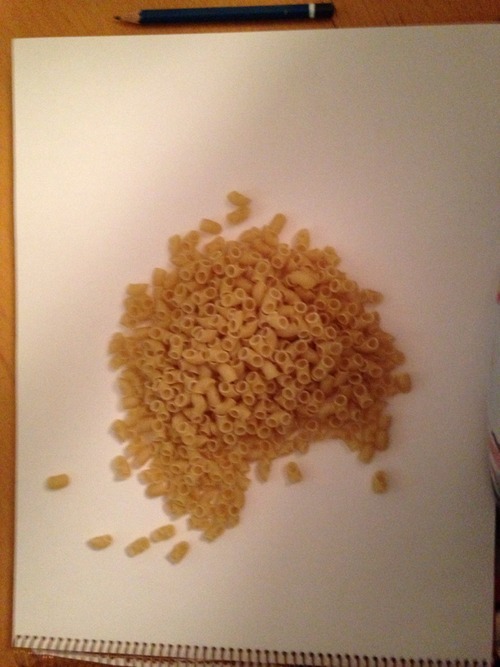
SOME MOTHER FUCKING MACCARONI (MAKE SURE THEY’RE DRY BRO DON’T WANT NO STICKY-ICKY MAP)
AIGHT THAT SHIT DON’T LOOK LIKE NO COUNTRY I KNOW (EXCEPT MAYBE AUSTRALIA FUCK THEM THOUGH)
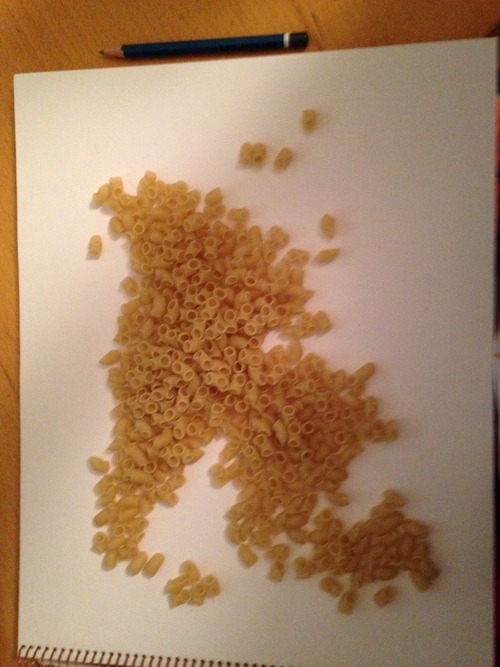
ORGANIZE YOUR MACCARONI! MAKE SOME FUCKING COASTLINES!
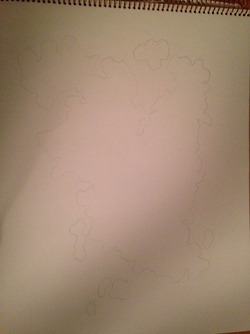
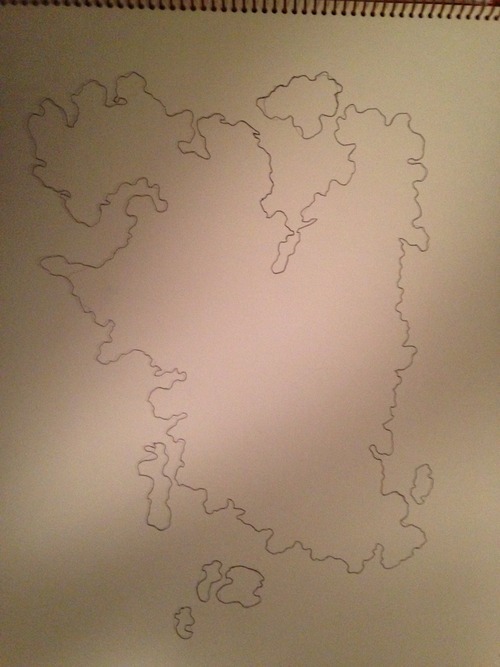
BETTER, BUT NOT FUCKING GOOD! WHATEVER, TRACE THE COASTLINE WITH YOUR PENCIL. BE SURE TO BE SLIGHTLY SQUIGGLY AND, OH, FUCK THOSE LITTLE ISLANDS YOU MADE THEY’RE NOT BIG ENOUGH TO BE WOBBLY ENOUGH SO YOU’RE BETTER OFF USING EITHER RICE (OR SIMILAR) OR JUST TRY TO MAKE SOME REALISTIC FUCKING ISLANDS (SPOILER: YOU WON’T)
GOOD ENOUGH I GUESS WHATEVER LOOK AT THAT VAGUE SORT OF ISLAND/COUNTRY/CONTINENT SHAPED PIECE OF SHIT. SEE THE ISLANDS? I FUCKING TOLD YOU SO DAWG.
NOW TAKE A SHARPIE AND MAKE EVEN SQUIGGLIER FUCKING LINES AS YOU FILL IN YOUR ISOUNINENT
LOOK AT THIS WONDERFUL PIECE OF SHIT IT TOOK ME LITERALLY TEN MINUTES TO MAKE TOPS AND NOW YOU JUST NEED TO FIGURE OUT WHERE TO PUT ALL YOUR DWARF-FUCKING ELVES AND LIZARD-PEOPLE WITH BOOBS
FUCKING GOOD JOB

How to avoid informed traits
You know those characters that are constantly referred to so smart or so capable or so sensitive (etc. etc.) by other characters or in the narration? And every time it comes up you find yourself shaking your head or rolling your eyes because the character in question either is as bland as boiled potatoes or constantly acts in ways that contradict those claims without explanation?
That’s what is commonly called an “informed trait”. You’re told the character is a certain way (or has a certain ability), but there is more or less nothing in the text to back that up.
It goes the other way around, too, with informed flaws that are supposed to make a character more relatable or interesting – think almost every romantic comedy leading lady who is supposedly “shy” and “clumsy”, but in a cute, endearing way that only ever comes up when the plot asks for it.
It’s frustrating, distracting, incredibly dull and at times downright insulting to the reader to encounter a story where one or more characters have a bad case of this, but unfortunately, it’s a pretty common weakness even in otherwise strong, well-written stories with interesting and complex character concepts.
Since characters and how the reader feels about them (whether they are supposed to relate to them, look up to them or feel repulsed by them) can really make or break a story, informed traits are an easy trap to fall into and many a writer’s Achilles heel.
So, how to avoid them?
This is where the trusty old “Show, don’t tell” comes in. You have most likely been told before that it’s usually better to go for subtlety and leave something to the reader’s imagination than to spell it out, and that is true.
It’s challenging to imply something without outright saying it. You have to get creative with the details you want to put into your story to get a point across by relying on your audience’s ability to read between the lines, and while it’s absolutely worth it to go the extra mile, you also run the risk of making your narrative too stilted and contrived instead.
However, there is a fairly simple trick to make your characterization feel more natural and insert it into the story smoothly:
Stop thinking of your characters as possessing certain traits and start thinking of their personalities as a collection of habits, preferences and specific abilities.
It might not sound like that big of a difference, but it will make translating your character traits into text much, much easier and save you a lot of trouble while editing.
Some examples:
- A “smart” character
This can mean a lot of things. You could have a character who is booksmart, learns quickly, reads a lot, can retain information easily and access it when needed, but has trouble applying theoretical knowledge in real life, someone who entertains their friends by telling them about weird facts and trivia, someone who can still recite poems they had to learn by heart when they were ten, someone with a tendency to talk in such complex run-on sentences they frequently forget what they were talking about half-way through.
Or you could have a character who is good at problem-solving instead, who likes puzzles and riddles, who gleefully obsesses over odd problems to find even odder solutions, but thinks so far out of the box in order to remain engaged in their current task they often miss the forest for the trees.- A “brave” character
Try to instead make a character who can never resist a challenge, who is a thrill-seeker and went bungee jumping about a dozen times already, who enjoys dragging their friends on the most dangerous looking rides in an amusement park and endlessly teases them about how pale they went afterwards. Make someone who simply cannot stand by when they see someone else get bullied, someone with a collection of scars they wear proudly and a story to tell about each one.
- A “shy” character
Forget about characters who blush prettily when spoken to and that’s it. Instead, write about a character who can’t make eye contact without forcing themselves to, who stumbles over their own words when talking to strangers, who is afraid of wearing bright colours because it might draw attention to them, someone who is humble and polite, but distant and comes across as cold or uncaring because they have tendency to hide their insecurity by retreating into themselves, even though seeming rude is the last thing on their mind.
Insert these habits into the story wherever they fit best. Be consistent in the portrayal of your character’s behaviour, even as character development kicks in. Adjust deliberately, but reasonably. After all, old habits die hard, so having your character break with one, however minor, can be a powerful moment with just as much emotional resonance as a flashy, dramatic scene meant to convey the same sentiment, and any “big” scenes will likely feel more organic if the reader has already seen traces of the necessary character changes before.
5 Fantasy Research Tips & Resources
Building a fantasy world is frankly one of the best parts of writing, if you ask me. You get to pull together all this eccentric stuff like Cornish mythology and breakfast tea and pirates and talking dogs and viola, somehow it meshes into this new exciting world. And the crazy thing is you get to do all this cool research, and then you can blow it out the window and dance to your own jazz! It’s your world, baby, so let’s build something.
But first, we’re going to have to…
1. Steal Stuff
The most successful fantasy worlds are based on the real world, or real world myths. Tolkien’s Middle Earth was inspired by Norse sagas and Anglo-Saxon culture and Narnia was very influenced by Greek mythology. Garth Nix’s fantasy series Abhorsen drew heavily on trench warfare in WWI. So when you set out to create a new world, have a look at things already exist, and see what you can steal.Medieval England has been plundered neigh to death, so maybe have a think about other times, places, or legends. Or maybe try to take on Medieval England from a different angle. Add some shazam to that soup!
One recommendation I’d give you: Try your hardest to base your fantasy story on something that isn’t someone else’s fantasy books. I’m not going to name names, but you can really tell when someone has just ripped off of Lord of the Rings. (Hint: It is called dragon but one of the letters is changed. You’ll never guess!)
Some fun places to look for inspiration: SurLaLune Fairytales, Planet Earth (that really long documentary your grandma likes), and ye local library.
2. Name Stuff
I find it really hard to brainstorm when I don’t have any names in place. So it’s time to name ALL the things! (Okay, not all of them, but all the really important stuff. Like countries.) I have been and always will be a fan of Behind the Name (and its cousin, Behind the Surname), where you can spend literal hours trolling through names. With fantasy, you might or might not want to change a letter or two, but for the uncreative or uninspired this is a good jumping point.Keep in mind the sound of the names you choose. You may not be up for all-out language creation (see below), but you should try to think about what your character/country names sound like. For instance, it might be a little hard to believe that characters named Alfarsi, Freud, Victor, and Dayo are all from a country called Leesong (unless Leesong is a super diverse country full of immigrants, in which case that’s totally cool).
If real names are getting you down, you might want to take yourself to my two BFFs: Oxford English Dictionary Online or Online Etymology Dictionary. The OED is a blessed place of glory and beauty, but it is also not free (unless you’re still using your college login information long after you graduated I mean haha what). Ety is free, but not as thorough. (However, it is arguably easier to browse if you’re just mindlessly trolling for words.)
Last but not least, this is a good article on Writer’s Digest about what to do/not do when you’re making names.
3. Make Maps
I’m going to cheat on this and just give you guys the link to a master post that’s far more thorough than I have space to be: The Whole Map on Tumblr.In case you don’t want to read that for some reason: Maps are important. You need maps to know where specifically your characters are moving and how far stuff is. If you hate the very thought of making a map, con one of your friends into doing it for you. (Hey, it worked for me!)
If you don’t need a full-scale country map, make a map of your characters’ environment. If it’s a boarding school, make floor plans (you can even use this handy floor plan builder). If it’s a ship, make ship plans. Do the thing! It will help with choreography, trust me.
4. Make Style-Guides
Take thineself to Pinterest and make a style guide (or take up thine glue stick and turn on thine printer). Then gather costume images from around the web, pick colors if you’d like (characters color favorites and/or country/flag colors), and paste them together (or post them on a Pinterest board) to create your characters’ unique wardrobes. Believe or not, the clothes your characters wear, and the material those clothes are made out of, says a lot about both the character and the world.Other (non-Pinterest) places to look: Costumer’s Guide to Movie Costumes, National Costumes of the World (25 of them, anyway), and Costume Institute at the Met.
5. Make Traditions
In some ways, this goes back to #1: Steal stuff. Look at our real-world traditions and give some thought to how you can adapt them to your fantasy setting. What sort of music does your culture listen to? How do they dance? When does the new year start, and how do they celebrate it? Do they have a religion, and how is it observed?Holidays and traditions should highlight what the cultures of your world value, and they can also be fun opportunities for showing off your characters and their beliefs.
(READ ON FOR THE BONUS RESOURCE. Or don’t. Whatever pleases you.)
EXTREMELY IN-DEPTH GUIDES TO DRAWING DIFFERENT ETHNICITIES
Part 1
Part 2
Part 3I am just crying tears of happy joy and whispering GAIAONLINE TAKE NOTE
‘the Irish head (skull) is one of the largest in Europe’
‘Irish are broad built and large boned’
‘Irish have characteristically thick eyebrows’
whelp
guess I know what to blame my problems on
thanks genetics
but no this is a great resource totally rad check it out
This is really, really fascinating!
i’ve been waiting for this reference for a million years
Tuesday Tips – VISUAL ANCHORS
Here’s a way to identify and use whatever is at your disposal when drawing a clothed figure. Think of the volumes and angles you’re drawing and use whatever defines them to “hide” the construction lines you might be tempted to use. This way, your sketches will look more organic and less academic. Good tip for cafe sketching.
-n
DBT Self-Help Resources: Emotions List
Using an Emotions List to help Label an Emotion
Some people are more adept at labelling their emotions than others. Some people just can’t seem to name what they are currently feeling. They might say that they felt bad or upset, but pinning down what that actually means for them is more challenging. Many people walk around in this kind of emotional fog.
Unfortunately, if you don’t know what you are feeling, you can’t do much to change it. People who can name their emotions are more capable of managing them, so it is important to become more familiar with your emotions and learn to identify them.
Once you are more capable of naming your emotions, you’ll have more choices in terms of what to do with an emotion if it makes you feel uncomfortable and you would prefer to at least reduce its intensity. Many people with emotion dysregulation grow up without learning this important information, so for some people it takes a lot of time to get the hang of naming their emotions. Be patient. If you get frustrated, reframe this process as if you are learning a new language. In fact, that’s exactly what is happening: you are learning the language of emotion.
Anytime you are unable to identify the emotion you are experiencing refer to the Emotions List. Reading through it, you should be able to find a word that closely describes the emotion that you are experiencing.
i made my cat listen to the audio clip in from the article + he loved it
That’s so cute omg I encourage everyone to try it and post results
i played the samples for quinn and she immediately laid down and really seemed to like it! this is so cute i would love to see shelters use this somehow
Color palette tutorial time!
This is by no means the Only Way To Pick Colors—it’s just a relatively-simple method I use sometimes. I’ve found it works pretty well, almost regardless of what colors you pick—as long as you can keep them organized by those light/dark warm/cool categories, and make sure one category takes up a significantly higher proportion of page space, it usually turns out pretty good!
I struggled with color for a long time before eventually reaching this conclusion, and here it is all laid out nicely for you lucky people by the talented and Eisner-nominated Melanie Gillman. So listen to them!
psdo:
*shrug*
important for any artist
Heck, show this to every man in the world who assumes he knows what boobs look like.
 theluminouscosmos