So, because people writing inaccurate kid!fic bothers me, a quick reference to kids (Disclaimer: I have no professional background in child development, and no offspring of my own – this is all based on other people’s kids.):
Newborn: Person-larva. Cannot do much but eat, sleep, cuddle, cry, poop. Cannot hold their own head up. May pick up on the mood of the person holding them, but response to it is going to consists of either contentment or complaining. Those are pretty much the two states of a newborn: happily cuddly or expressing displeasure.
2 – 6 months: Somewhat more aware of surroundings, own appendages, etc. Will recognize people, like some better than others. Smiles, laughs, babbles. Somewhere in here rolling over commences, and possibly crawling. Starts teething.
6 -12 months: Lots of babbling, but no actual talking. Crawls, pulls self up to standing while holding onto things, may start wobbly independent walking. Some kids are climbers (may heaven help their parents). Eating some solid food (as in, mashed up stuff), but still nursing / drinking formula too. This is the beginning of the exploratory, everything-goes-in-the-mouth stage. Still teething.
1 year old: Has teeth, eats solid food. Many parents wean at this age, but it’s not unusual to continue breastfeeding. Talks, but probably not very clearly – pronunciation will be interesting, and vocabulary very limited. May repeat a new word incessantly. Points at things they want. Physical coordination and verbal skills increase as child gets older. Maybe develop utterly random phobias, usually of things that are new or unpredictable. Interested in other children, may mimic older children. Still sticks everything in their mouth.
2 years old: Speaks well enough to be understood by those who know them, but not necessarily strangers. Uses simple phrases. May mash words together to express a concept for which they don’t yet know the word, or make a word up. Is learning labels for things, though they may not be accurate (i.e. all old men are grandpa, all round objects are a ball, etc.) Knows colors, parts of the body, types of animals, etc. Walks, runs, dances, etc – basically the full range of physical stuff, just all of it is kinda awkward. Can roll a ball or throw it in a clumsy way. May have a favorite toy, security blanket, etc. May play pretend games or make up stories, but they’re likely to be fair inscrutable to adults. Wants to do things independently, but is likely to be easily frustrated. Has tantrums. Plays with other children, but not terribly good at sharing or being nice. Asks questions; the ‘why?’ stage has begun. Toilet training begins around this age; girls tend to get the hang of it quicker than boys.
3 years old – pretty much the same as 2, only a bit better at all of it. Asks a LOT of questions. Has friends. Plays pretend. Understands rules (though is unlikely to obey them very well). Can count, though not very far. Speaks well enough to be understood by strangers; you know that so-cute-you-could-die kid-speak people love to write? This is the appropriate age for it (up through about age 5).
4 to 5 – cutesy kid-speak is age appropriate. May still have tantrums, still not the best at sharing, but should be starting to get socially functional. Can throw or kick a ball, jump, stand on one foot, all that. Can count, recite alphabet. Some kids start learning to read and write arond this age, though it wouldn’t yet be abnormal for them not to be able to. Lots of pretend play. Emotionally intense; everything is dire. Learning to be self-maintaining, i.e. may bathe independently but needs an adult to wash their hair.
6 – 10 – speaks like an emotionally immature adult; the things they have to say are still kid-like, but they should be easing out of kid-speak. Reads, writes, can do math – these skills increase with age. Understands and (usually) obeys rules, has a concept of fairness, kindness vs. cruelty, etc. Forms tight friendships, keeps secrets, wants to fit in and be liked; having a best friend or a group of friends is the most important thing in their world. Wants to be good at things; has definite interests and academic strengths and weaknesses. May bully or be bullied; kids this age can be mean. As in horrifyingly so. Has crushes (though probably still finds it acutely embarrassing). Understands death. Kids this age will curse, though hilariously badly. Still wants parental affection, but probably not in public.
11 – 12 – mini-teen, which is to say emotionally vulnerable, short-sighted mini-adult. Naive still, but not terribly so – has a basic understanding of human nature, events around them, etc. Begins to form political / ideological / religious opinions. May begin reciprocal romantic attachments. Strongly focused on collective identity, what ‘niche’ or ‘crowd’ they identify with. Some girls start puberty. This is also the age of things going badly wrong; kids know which other kids are the sociopaths at this stage. While everybody else is learning how to not be a mean little shit to everybody unlike themselves (or a bitter perpetual victim), those few who aren’t developing in a good direction become downright terrifying.
13 – 15 – somewhere in here, kids will start either facing major adult-scale decisions and problems themselves, or seeing peers doing so. Shit gets real. This is why teenagers think they know everything; the rose-colored glasses of childhood fall off, and they are suddenly So Very Jaded and cannot imagine there being more to the world than what they can suddenly perceive now, because it is overwhelming. Likely to be angry at the world, likely to gravitate toward ideological extremes. Takes risks. Forms romantic attachments; may experiment sexually, may not, maturity levels here very A LOT.
16 – 21 – moody adult with far more curiosity than common sense. Does thing in grand and dramatic fashion. Experiments with different identities. Wants total independence. Many develop greater social maturity around this time; stop seeing others in terms of cliques, develop greater empathy and ability to see things from multiple perspectives. Forms romantic attachments that may be serious or even life-long.
ALSO, if you own Prismacolors Color Pencils and they keep breaking off no matter how much you sharpen them, they are cracked from the INSIDE.
This can be fixed by putting them in the microwave for no longer than 3 seconds! A little thing my art teacher taught me and has come in handy like heck!
This is thorough, easy to follow, and funny as hell. If you don’t know where to start on Sketchup and want to use it for comics or illustration, READ THIS.
this formatting is making me uncomfortable but I have to tell you something / ask you something that is vital to my career as a student.
I re-read and edited that sentence for an hour, but you’ll probably just glance over it for half a second.
thanks!
– [name]
k
-professor
I have a stock format and structure I use.
Dear Person I am Writing To:
This is an optional sentence introducing who I am and work for, included if the addressee has never corresponded with me before. The second optional sentence reminds the person where we met, if relevant. This sentence states the purpose of the email.
This optional paragraph describes in more detail what’s needed. This sentence discusses relevant information like how soon an answer is needed, what kind of an answer is needed, and any information that the other person might find useful. If there’s a lot of information, it’s a good idea to separate this paragraph into two or three paragraphs to avoid having a Wall of Text.
If a description paragraph was used, close with a restatement of the initial request, in case the addressee ignored the opening paragraph.
This sentence is just a platitude (usually thanking them for their time) because people think I’m standoffish, unreasonably demanding, or cold if it’s not included.
Closing salutation,
Signature.
People always ask me how I can fire off work emails so quickly. Nobody has figured out yet that it’s the same email with the details changed as needed.
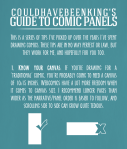
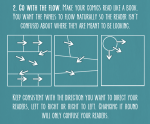
The most important tip I could ever give towards drawing/creating good comics is to read comics. Good, bad, mediocre, read them all and learn from them.
i use overlay all the time to make colours more vibrant and to make areas warmer or cooler. good for colourful ambient light (like glowy magic stuff).
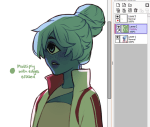
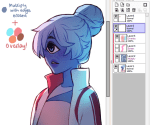
multiply is really good for establishing a light source very quickly!! play around with the hue to get shadows with cool colours. for more detailed work you can use two or three tones on a multiply layer for more dimension.
screen is something i only recently started using regularly! it’s really great if you have a very bright light source. you can also use screen and paint on the edges of a backlit character to make the lighting more intense. a good thing to know about screen layers is that the darker the colour you use, the less it lightens; using black on a screen layer leaves no effect on the colours underneath (the opposite is true for multiply layers!).
and you can also use these layers for an entire painting instead of just on a character! i don’t have a visual example on hand, but stuff like making the area around a warm light source warmer, making a light source brighter and more vibrant, or using gradients set on multiply or screen are just some of the ways you can apply these to a full painting 🙂
I’ve said this to my non-techie friends countless times. It’s no secret that being able to code makes you a better job applicant, and a better entrepreneur. Hell, one techie taught a homeless man to code and now that man is making his first mobile application.
(note: yes I realize that 3/5 of those links were Google projects)
But most folks are intimidated by coding. And it does seem intimidating at first. But peel away the obscurity and the difficulty, and you start to learn that coding, at least at its basic level, is a very manageable, learnable skill.
There are a lot of resources out there to teach you. I’ve found a couple to be particularly successful. Here’s my list of resources for learning to code, sorted by difficulty:
Novice
Never written a line of code before? No worries. Just visit one of these fine resources and follow their high-level tutorials. You won’t get into the nitty-gritty, but don’t worry about it for now:
w3 Tutorials (start at HTML on the left sidebar and work your way down)
Intermediate
Now that you’ve gone through a handful of basic tutorials, it’s time to learn the fundamentals of actual, real-life coding problems. I’ve found these resources to be solid:
If you’re here, you’re capable of building things. You know the primitives. You know the logic control statements. You’re ready to start making real stuff take shape. Here are some different types of resources to turn you from someone who knows how to code, into a full-fledged programmer.
Programming problems
Sometimes, the challenges in programming aren’t how to make a language do a task, but just how to do the task in general. Like how to find an item in a very large, sorted list, without checking each element. Here are some resources for those types of problems
If you learned Python, Django is an amazing platform for creating quick-and-easy web applications. I’d highly suggest the tutorial – it’s one of the best I’ve ever used, and you have a web app up and running in less than an hour.
I’ve never used Rails, but it’s a very popular and powerful framework for creating web applications using Ruby. I’d suggest going through their guide to start getting down-and-dirty with Rails development.
If you know PHP, there’s an ocean of good stuff out there for you to learn how to make a full-fledged web application. Frameworks do a lot of work for you, and provide quick and easy guides to get up and running. I’d suggest the following:
If there’s one point I wanted to get across, it’s that it is easier than ever to learn to code. There are resources on every corner of the internet for potential programmers, and the benefits of learning even just the basics are monumental.
If you know of any additional, great resources that aren’t listed here, please feel free to tweet them to me @boomeyer.













 theluminouscosmos